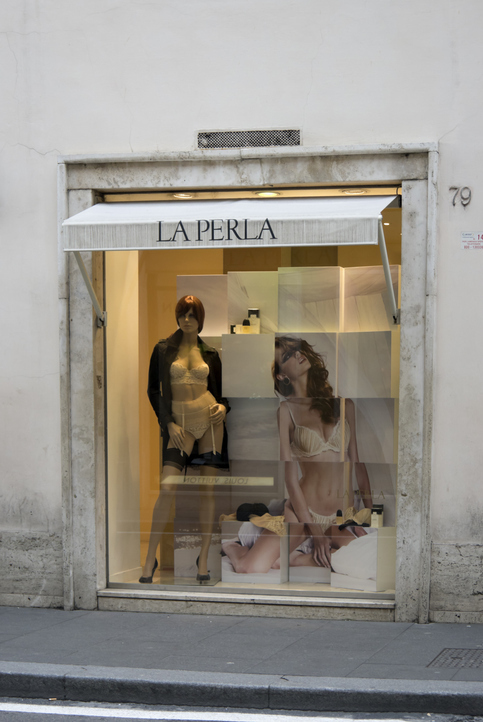
The Wall Street Journal recently published a profile of La Perla, the iconic Italian lingerie brand that nearly vanished and is now slowly coming back to life. The story it tells deserves a wider audience, because it speaks to something we think about often: what patient, values-driven capital makes possible, and what happens when it is absent.
La Perla was founded in Bologna in 1954 by Ada Masotti, a master corset maker who built her atelier around a simple philosophy: never compromise on quality, and never stop innovating. Her son Alberto took the helm in 1981 and led the company through its international expansion, building it into a globally recognized brand. The Masotti family ran La Perla for over 50 years. At its peak the brand was generating over 250 million euros in annual sales, with handsewn lingerie worn by Beyoncé and Margot Robbie, featured in Vogue, and woven into shows like “Sex and the City” and “Emily in Paris.”
In 2007, Alberto sold the company to US private equity firm JH Partners, and the long unraveling began. Over the next 17 years the brand passed through multiple financial owners, each unable or unwilling to give the business what it actually needed. The last of them, a private equity firm called Tennor run by German businessman Lars Windhorst, promised 60 to 70 million euros to relaunch the brand. That financing never materialized. Instead, management expanded into beauty and swimwear, joined Amazon Luxury Stores, and sank $50 million into British couture house Ralph & Russo, which has since closed. By early 2024, an Italian court had declared La Perla insolvent. The trade union Filctem Cgil summed up the mood, demanding an end to “financial speculations such as those undertaken by the Tennor fund.”
What makes this more than a cautionary tale about bad ownership is what happened next. Most of La Perla’s artisans, women who had nicknamed themselves the “Perlines,” had been at the Bologna atelier for 30 to 35 years. Many had joined after high school and spent years mastering tasks like hand-applying lace to silk, a process that can take four hours per garment. These are not skills you can acquire quickly or replicate at scale. When the company collapsed, the Perlines did not go quietly. They lobbied the European Parliament and campaigned publicly for over a year to save both their jobs and their craft.
Into this situation stepped Peter and Kirsten Kern, an American couple who had been longtime admirers of the brand. Peter is the former CEO of Expedia, and the Kerns have deep ties to Italy, where they live part of the year and have invested in the wine industry. Peter has been nicknamed “Mr. Brunello di Montalcino” in local circles. It was reportedly Kirsten who first encouraged Peter to pursue the acquisition.
The deal closed in June 2025, at approximately 25 million euros, with a business plan committing nearly 30 million euros in additional investment through 2027. The timing matters. The global luxury market is in one of its most difficult stretches in years. According to Bain & Company, luxury spending was essentially flat in 2024, with the overall customer base shrinking by roughly 50 million consumers over two years, driven by economic uncertainty, sustained price increases, and declining enthusiasm among younger shoppers. Bain’s mid-2025 report describes the sector as facing its most far-reaching disruptions in at least 15 years. The Kerns made their bet anyway, and with eyes open.
Although some competitors submitted higher bids, the Kerns prevailed because they pledged that manufacturing and product development would remain in Bologna. Peter took the role of chairman, while Paolo Vannucchi, who had previously led the brand during the Scaglia era, returned as CEO, bringing back the operational leadership that understood the brand from the inside. The Kerns provided the capital and the long-horizon commitment; an experienced team is running the day-to-day revival.
The investment is not just financial. The Kerns are betting on craft itself as a competitive advantage. Rather than rebuilding through mass retail, they are reconnecting with customers through intimate trunk shows where the seamstresses work directly with buyers. They are partnering with Italian technical and design schools to train the next generation of artisans, a commitment that requires genuine patience: senior pattern makers take up to eight years to fully develop their craft. This is an investment in human capital as much as it is in a brand, grounded in the recognition that the two are inseparable at La Perla.
“What these women do is unbelievable in terms of the craftsmanship and the attention to detail,” Kirsten Kern told the WSJ. “We were committed to keeping everything about the employees and the quality from day one. We were never interested in just taking the brand and running away with it.” Peter Kern put it plainly: “The artistry of what we do is in the people. It’s the renaissance of a great craft of a brand with iconic history.”
La Perla’s own website captures the spirit of the revival simply: “La Perla and its Atelier are entering a new era, where unrivaled craftsmanship meets a modern vision of femininity, carrying forward the heritage that shaped the world’s finest lingerie.”
The contrast at the heart of this story is worth sitting with. The financial owners who cycled through La Perla between 2007 and 2024 were not lacking in capital. What they lacked was a reason to care about the craft. When your investment horizon is defined by a fund cycle, and your return is measured in multiples, the seamstresses and their four-hour garments look like inefficiency. When your horizon is longer, and your motivation is something other than extraction, the artisan craft is the core of the reincarnation.
Private capital is often discussed purely in terms of its financial characteristics: its flexibility, its patient structure, its freedom from quarterly reporting. But its most important characteristic may be simpler than any of that: it allows the people deploying it to invest according to what they actually value. The Masotti family valued craft, and they built something that lasted half a century. The Kerns appear to value it too, and they stepped in at the moment it mattered most. In a world where short-term financial logic has a way of crowding out everything else, that kind of ownership is rarer, and more consequential, than it might seem.
Barbara Zappoli, chief product officer at the atelier, offered the clearest summary of what is at stake: “The human touch is the real essence of La Perla. It’s about women making things with their hands for other women.”
The Perlines are back at their stations in Bologna. That is what values-based private capital made possible.
——
For more content, check out Wingspan Insights